The Quiet Rules That Protect Capital in Abuja Real Estate

Edition: May 18, 2026
Publishing Rhythm: Bimonthly, 1st & 3rd Monday of Every Month
What Most Buyers Are Never Told, Until It’s Too Late
A property can be cheap and still be expensive.
An estate can look organized and still be unsafe for your capital.
And a deal can feel urgent, yet quietly trap your money for years.
Over the last week, after the previous edition on busy estates that don’t grow in value, I received a flood of messages that all sounded similar:
“How do I know a property is actually safe before I pay?”
“What should I check beyond price and location?”
“How do I avoid buying what looks good but turns into a problem?”
We originally planned to continue with another market-performance topic this week. But based on these requests, it became clear that buyers are more worried about making irreversible mistakes than missing opportunities.
So this edition shifts focus, deliberately.
The Truth Most Buyers Learn Too Late
Most people think they lose money in Abuja real estate because they chose the wrong location.
That’s not always true.
What actually destroys value is buying without a system, relying on price, pressure, or surface impressions instead of structured verification. After years of studying transactions that worked and those that quietly failed, one thing is clear:
Successful buyers don’t just find properties. They eliminate risk, methodically.
This edition is not about fear. It’s about clarity. Below are the core principles smart buyers use to protect capital, framed simply, practically, and decisively.
1. Never Treat “Cheap” as a Signal, Treat It as a Question
In Abuja, price is not value. Price is a symptom.
When a property is significantly cheaper than its peers, experienced buyers don’t rush, they investigate.
They ask:
- What risk is already priced in?
- Is access compromised?
- Is infrastructure delayed or uncertain?
- Is the title limited, conditional, or encumbered?
Professional rule: A cheap property that absorbs future costs is more expensive than a fairly priced one that compounds value.
2. Separate Advertised Price From True Exposure
Many buyers commit emotionally at the advertised price, and financially regret the total cost.
True exposure includes:
- Legal verification
- Survey confirmation
- Documentation and perfection
- Agency and professional fees
- Estate or development levies
Professional rule: You haven’t evaluated a deal until you’ve calculated the all-in cost and compared it to realistic exit value.
3. Confirm Ownership Before You Trust Intentions
Good manners don’t equal legal authority. In Abuja, property is often marketed by:
- Developers without final authority
- Family members without consent
- Agents without verified mandates
Professional rule: Money should never move until ownership and selling authority are independently confirmed, not assumed, not promised.
4. A Title Is Not the End of Due Diligence, It’s the Beginning
Many buyers stop at “there is a title.” Professionals go further.
They verify:
- Authenticity
- Encumbrances
- Pending claims
- Government interests
- Land charges and obligations
Professional rule: A title that cannot be perfected, transferred, or defended is not protection, it’s exposure.
5. Ensure the Survey Describes Your Property, Not a Similar One
One of the most silent but costly errors is buying land whose survey:
- Covers a different portion
- Overlaps government land
- Conflicts with existing layouts
- Doesn’t match what’s being sold
Professional rule: If the land on paper doesn’t match the land on ground, ownership is uncertain, regardless of payment.
6. Never Assume “Estate” Means Structure or Safety
The word estate is descriptive, not protective. Some estates:
- Lack proper approvals
- Have weak layouts
- Depend on future promises
- Suffer from infrastructure delays
Professional rule: An estate is only as strong as its planning, governance, and delivery timeline, not its gate or branding.
7. Evaluate Infrastructure by Timing, Not Promises
Infrastructure creates value, but only when it arrives. Professionals assess:
- What exists today
- What is funded
- What is speculative
- What is delayed
Professional rule: Value grows when infrastructure meets demand at the right time, not when it’s eternally “coming.”
8. Inspect Personally, Marketing Cannot Replace Ground Truth
Photos hide gradients. Videos hide drainage behavior. Brochures hide access challenges.
Professional rule: If you haven’t walked the property, traced access routes, and observed the environment, ascertain its security, you don’t fully understand the asset.
9. Choose Payment Structures That Protect Flexibility
How you pay matters as much as what you buy. Poor structures can:
- Lock up liquidity
- Remove leverage
- Increase exposure
Professional rule: Smart buyers align payment terms with verification milestones, not pressure timelines.
10. Buy With an Exit in Mind, Always
Every serious purchase answers three questions:
- Who will rent this?
- Who will buy this next?
- Under what conditions will demand weaken?
Professional rule: If exit is unclear, value is fragile, regardless of location.
Where the Abuja Valuation Lens Fits In
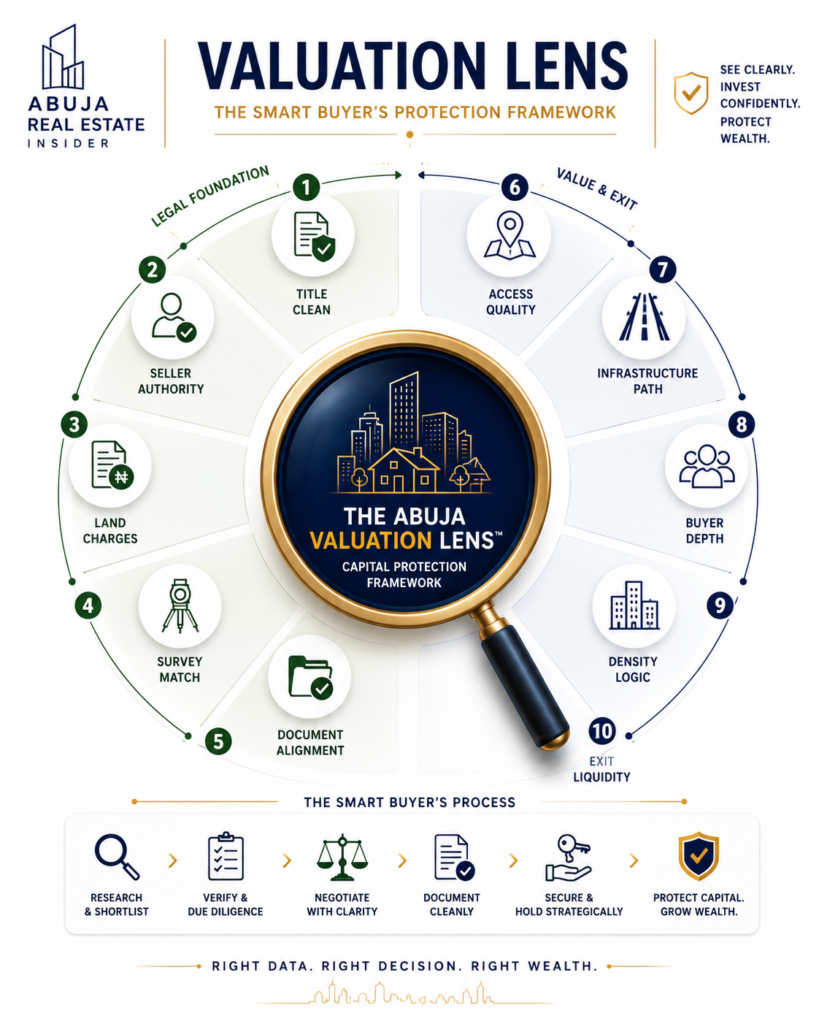
These principles are not isolated checks. They are interconnected.
That’s why I introduced the Abuja Valuation Lens, to view every property through two non-negotiable filters:
- Legal Safety (title, ownership, survey, encumbrance, authority)
- Economic Resilience (infrastructure timing, buyer depth, liquidity, exit strength)
When both align, capital is protected. When one is weak, risk compounds.
Final Thought
Most buyers don’t lose money because they lack information. They lost money because they lacked structure.
This edition is meant to be a reference, not a reaction. Something you return to before committing, not after regretting.
Coming Next
In the next edition, we’ll explore what buyers often miss when a property is selling “too fast”, and why speed can sometimes hide fragility.
If you missed the previous edition or want to review its Valuation Lens framework, you can still access it here: https://bashirademolayusuf.com/why-some-abuja-estates-feel-busy-yet-fail-to-grow-in-value-and-what-that-means-for-your-next-move/
And if you need help applying this lens to a specific opportunity, that conversation usually starts quietly, before the market notices.

Whether you’re looking to invest in a luxury apartment, a sprawling villa, or anything in between, I’m here with my team to guide you every step of the way. Contact me today for personalized guidance and exclusive investment opportunities.
